
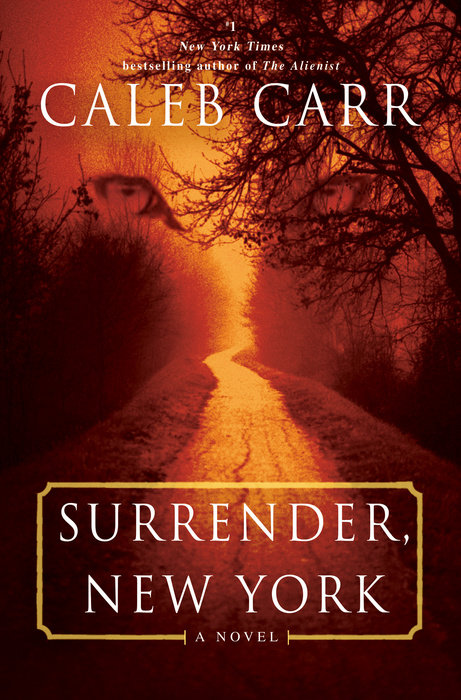
We have marked some major anniversaries in Caleb Carr’s career over the past few years, and 2026 brings us to another. Ten years ago, Caleb published Surrender, New York, his first—and only—foray into contemporary crime fiction. This novel, which would prove to be his last work of fiction, sparked considerable debate when it first hit the shelves. Although bestselling crime novelist Michael Connelly gave the work a glowing front-page review in The New York Times Book Review, critics and general readers were more divided. Some loved the intricate detail and deeply personal nature of the novel, while others took issue with some of its more unconventional qualities.
As we have never done a deep dive into Surrender, New York here at 17th Street, I thought that today—on what would have been Caleb’s 71st birthday—might be a fitting time to begin. Due to the work’s complexity, there are many potential routes we could take, but it seemed wise to start at the beginning with the most basic of questions: Why did Caleb decide to create a fictitious town (and county) in upstate New York as the setting for the novel, and where, precisely, is the quiet town of Surrender supposed to be located?
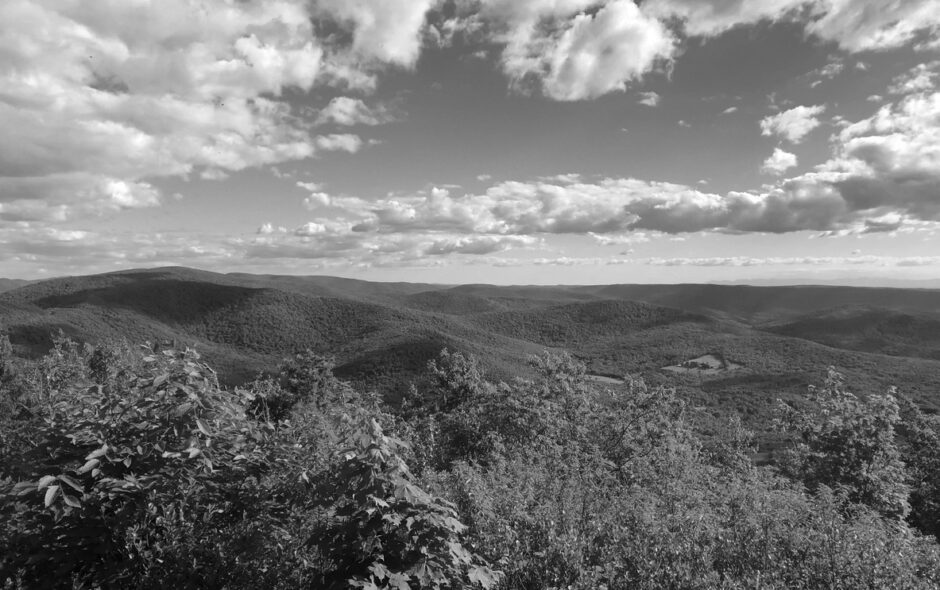
And so, let us start yet another anniversary journey by grabbing a sturdy pair of hiking boots, picking up our copies of the novel, and venturing into the wilds of the northern Taconic Mountains as we trace Caleb’s footsteps on our way to find Surrender.
Surveying the Landscape
It should come as no surprise to any of Caleb’s readers that place is often as much a character in his fiction as is the human cast that populate his pages. As early as his first novel, Casing the Promised Land, we can see the influence that setting has always had on its author. Towards the end of Casing, the novel’s protagonist, Jason, reflects on what his hometown of New York signifies to him. Importantly, it offers us a glimpse of what the city might mean to the author, too:
Whatever else New York may be, she’s a kind of mother and she does love her children. She loves them when they wander, because she knows they’ve got to come back and she knows why they do. A cab driver once told me that the only thing better than leaving New York is coming back to it—when you’ve grown up on the city’s streets you know that cabbie’s words are true, and you love it to be that way. On every return the skyline of Manhattan grows; it grows, keeps growing until suddenly you’re within it, and every dream that the city has ever ignited is rekindled.
Casing the Promised Land
Although Caleb would not return to fiction for another fourteen years, it was once again the City of New York that featured as one of his central characters when he did. His breakthrough 1994 novel, The Alienist, took readers deep into Old New York. Indeed, it was part of the work’s general appeal that readers felt transported back to the city streets of 1896, with all their smells, sights, and sounds as vividly portrayed as though they were happening in the moment. Its sequel, The Angel of Darkness, also returned readers to that same New York; however, this work went further by expanding the horizon north to Caleb’s other heartland, upstate New York—a landscape he would not revisit in fiction for nearly another twenty years, until Surrender, New York.
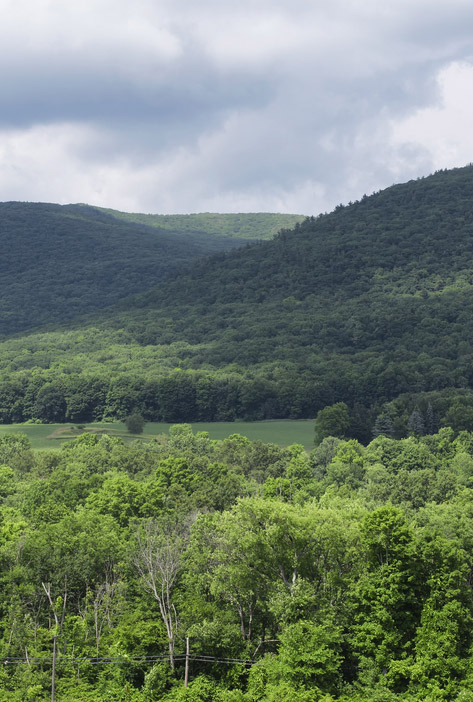
Caleb’s decision to feature upstate New York in both The Angel of Darkness and Surrender, New York is no mystery. His love of the area can be traced to fond childhood summers spent at his grandparents’ property in Cherry Plain, a hamlet located at the base of the Taconic Mountains in Rensselaer County. He continued to visit throughout his life, but it was the success of The Alienist that allowed him to purchase the neighboring estate, known as Misery Mountain Farm, in the late ’90s and move to the region permanently.
The question, then, is not so much why he chose to set two novels in upstate New York, but why he changed course in adhering to geographic realism between the two works. The Angel of Darkness features only real locations. Our first glimpse beyond the city in the novel is when the team board the Mary Powell, a real Hudson River steamer from the time, to view the majestic beauty of the Catskills from its deck. From there, they travel by rail to the small town of Ballston Spa in Saratoga County, which serves as their base for a large section of the novel. Notably, all of the villages and towns the characters visit are identifiable and described in historically accurate detail. So when Caleb decided to return upstate two decades later, it seems reasonable to ask what prompted him to lay aside the real map and draw one of his own, especially as Surrender was intended to sit in the same ‘universe’ as the Alienist novels.
Finding Surrender
The protagonist of Surrender, New York is Dr. Trajan Jones, a criminal psychologist and expert on Dr. Laszlo Kreizler’s theory of context from the Alienist books. References to Kreizler pepper the novel, placing us firmly in the intellectual territory of Caleb’s earlier work. Yet, from page one, it is made clear that we must learn a new geography. The action takes place in fictitious Burgoyne County, in which the equally fictitious town of Surrender is located. Several other invented towns are also named in the work, including Burgoyne’s county seat of Fraser. However, the landscape is not entirely fictional. Real highways, towns, cities, and natural features are also present in the work, making it clear that Burgoyne County is meant to exist alongside the real geography of the area rather than in place of it.
Fortunately, the retention of real landmarks also serves as a helpful clue, allowing readers to reconstruct the approximate locations of many of the fictitious towns in Burgoyne. In terms of the real geography of New York State, we learn early on that the town of Surrender is meant to be located in one of “a half-dozen valleys that lead down from the high ground of the northern Taconic Mountains” (p. 3), but it is the town’s description and history, recounted in Section Five of Chapter One, that provides us with the full context needed to localize it. Caleb writes:
The name “Surrender, New York” has long been a source of amusement for passing voyagers making their way north from “the city,” or east from the state thruway to Vermont and other points in northeastern New England. The one-word directional sign on Route 7 that points the way to the town is in fact no more than that: an old rectangular piece of standard highway green sheet metal making the turn onto a lonely byway and toward the northern Taconics beyond.
Surrender, New York
He goes on to explain that the town is “nothing more than a small, tumbledown hamlet at the crossroads of County Road 34 and another, unnumbered byway: a village with little to recommend it other than a seemingly common Civil War monument in the small square at its center” (p. 50). It should be noted that there is no real County Road 34 anywhere in the vicinity of Route 7, so this road, unfortunately, does not help to provide the marker we need to identify Surrender’s ‘true’ placement. However, the paragraphs that follow do give us helpful hints. In the novel, Surrender claims to be the site where the bulk of the British troops defeated at the Battle of Bennington surrendered on August 16, 1777. Although nearby Bennington, Vermont, gave the battle its name, it is across the border in New York where the battlefield site was actually located, a little way north of the real town of Hoosick Falls.
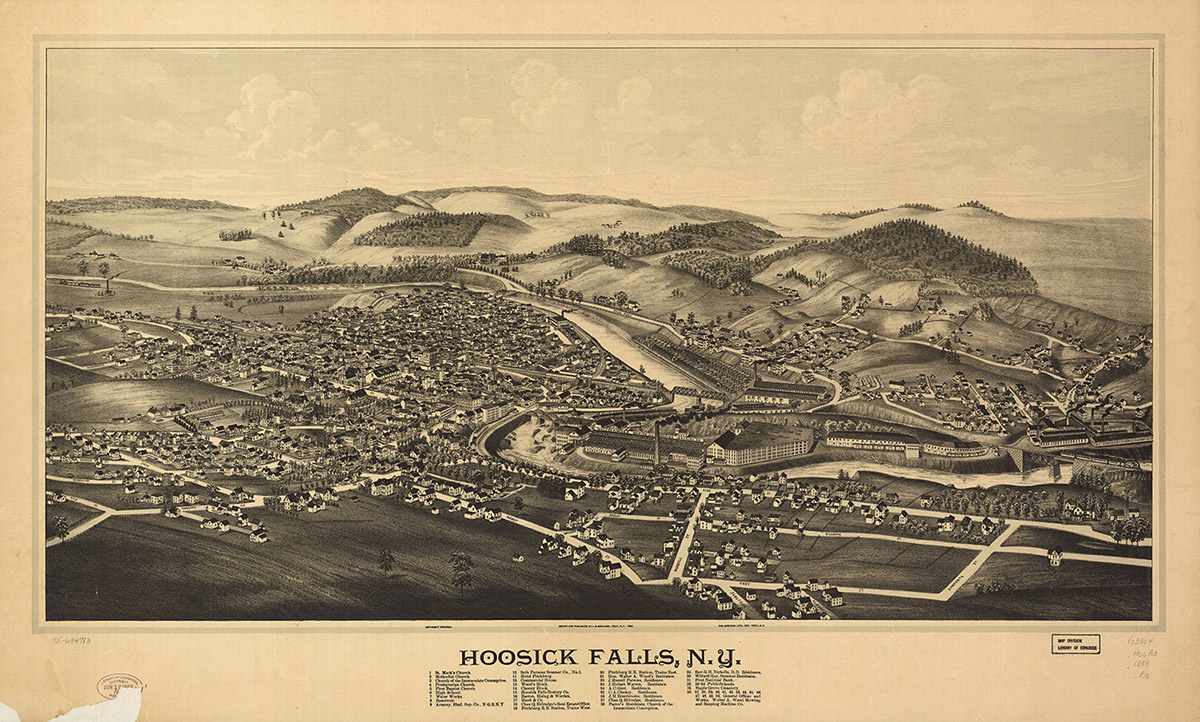
In combination with the highways and the Taconics themselves, Hoosick Falls acts as the most important geographic marker in Surrender, New York. Even though the picturesque town is a real historic community located in northeastern Rensselaer County, in the novel it appears to have been incorporated into Burgoyne. Specifically, as described in Part One: Chapter Three (Section One), to travel between the town of Surrender and Burgoyne’s county seat of Fraser, the characters must travel “in a zigzag pattern along several of the area’s major highways” (p. 124), first navigating a stretch of Route 7, then turning north onto Route 22 which takes them through Hoosick Falls, and finally staying on the highway until they reach Fraser. Given that Surrender lies south of Hoosick Falls in a valley of the Taconics, and Fraser serves as the county seat, the route would make little geographic sense unless Hoosick Falls also falls within the county. Thus, on the basis of these clues, an approximate map of locations is shown below.
| Title | Category | Address | Description |
|---|
Although the approximate location of Surrender can be established with reasonable confidence, Fraser proves more elusive. The novel identifies Burgoyne’s county seat as a satellite of Albany through which Route 4 (along the Hudson River) passes, suggesting a settlement within the same corridor as the real city of Troy. However, Troy itself is also featured in the novel, making it clear that the two cannot be one and the same. Furthermore, the route described between Surrender and Fraser—traveling along Route 7, then north on Route 22—would be confusing, to say the least, if Fraser occupied Troy’s location, as the journey could instead be made directly west along Route 7. For these reasons, the map places Fraser only approximately, further north along the Route 4 corridor in the vicinity of the real city of Mechanicville.
It should be noted also that a handful of fictional towns have been left off this map. Despite North, South, and West Briarwood being featured in the novel, there are simply not enough geographic clues to identify their precise locations. I leave it up to readers to provide their best interpretations as to placement.
A Literary Tradition
Of course, simply being able to recreate Caleb’s intended map does not explain why he felt the need to invent Burgoyne County in the first place. After all, if towns like Hoosick Falls and Troy were included in the novel, why not use real locations throughout? To answer this question, perhaps one needs to look further afield to other authors who made similar decisions. Although many authors have invented a town to house their fiction (e.g., Agatha Christie’s St. Mary Mead), fewer have invented entire counties. Of those that have, their reasons have varied, but the similarities are informative.
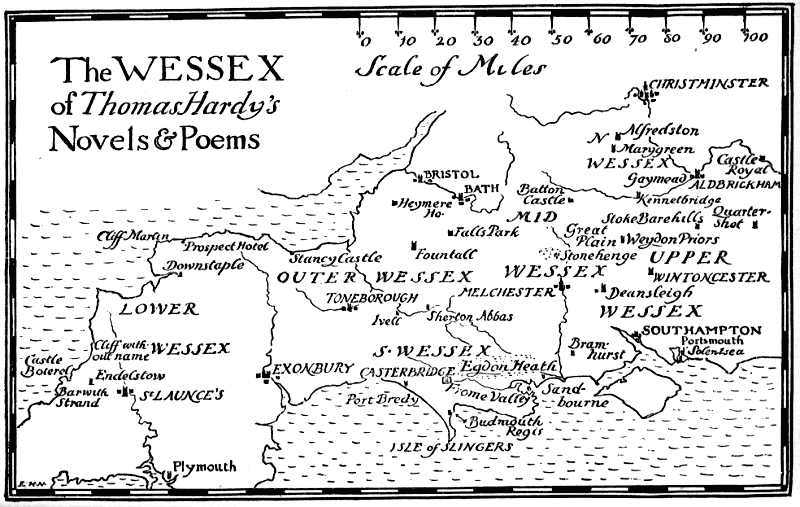
Anthony Trollope’s fictional county of Barsetshire formed the basis of his Chronicles of Barsetshire series, published between 1855 and 1867. Inspired by real British counties, the fictional county and its cathedral town of Barchester were crucial in allowing Trollope to develop a consistent social, political, and ecclesiastical world over the six novels of his series without being constrained by the exact geography or institutions of any one real county. Similarly, Thomas Hardy revived the ancient name of “Wessex” for a largely fictional version of south-west England that formed the setting of his major novels. As with Trollope, many of the Wessex towns and landscapes were based closely on real places in Dorset and neighboring counties, but fictionalizing the region gave him the freedom to reshape geography and chronology in service of the stories.
Crossing the Atlantic, perhaps the best-known fictional county in American literature is William Faulkner’s Yoknapatawpha, modeled on Lafayette County, Mississippi. Faulkner developed the county to such a degree that he created his own maps and it became the setting for many of his novels and stories. Given Faulkner’s desire to explore the legacy of the Civil War in the South, his use of a fictional county allowed him to examine heavy social and political themes such as racial segregation more effectively than if he had set his work in real communities instead.
Burgoyne County therefore belongs comfortably within this tradition. Like Hardy’s Wessex and Faulkner’s Yoknapatawpha, Burgoyne is less an invention than a reimagining of Caleb’s own Rensselaer County: a fictional landscape laid carefully alongside a real one. His motives may have been similar, too. In an interview with Literary Hub in 2016, he explained his reasons for exploring sensitive themes such as poverty and corruption in the novel:
“In my earliest memory, the vibrant communities were already on the downslope when I came along,” he said of the dead industry and boarded business districts in the nearby little towns. “Many of them are just ghost towns now.”
In The Alienist, the corruption reached into the police department and city government. Carr sees the same corruption in the small towns of upstate New York, going all the way to the governor’s office in Albany. There are brutal cops who beat confessions out of subjects and corrupt district attorneys. “I’ve integrated myself into the area,” said Carr. “The deeper you get, the worse the corruption. There is this naked ambition and desire to get to another place.”
In 2005, Carr ran for local office as a favor to a friend. He had no desire to win and didn’t. “I learned how bad things are from the ground up,” said Carr. “I saw people I knew to be criminals being elected. It’s ground-up corruption. That is why Albany is the most corrupt capitol in the country.”
Literary hub
Yet thematic content may only have been part of the equation. Caleb appears to have recognized that the protective distance between a novel’s setting and the real region it is based on can also function to shield the individuals who live in and around the communities an author is inspired by, something he addressed directly in the novel’s Acknowledgments section: “A word about contemporary fiction: when one shrouds one’s work in history, the unfortunate tendency of readers to try to identify just who in a writer’s life inspired which character is suspended—return to our own time, and that tendency is immediately resumed.”
Thus, understanding why Caleb broke with his usual geographic accuracy to create Surrender and the broader county of Burgoyne requires more than tracing roads and county lines on a map. Looking at the themes Caleb chose to explore, along with recognizing his respect for, and attachment to, the inhabitants of the corner of New York State he called home for more than two decades, is the only way one can truly grasp why he made such a deviation for his seventh and final novel.
I hope you’ll join me over the coming months for Part Two as we explore Surrender, New York’s themes in greater depth, before concluding in Part Three with a treasure hunt for some of the literary, cinematic, and musical influences that are interwoven throughout the text—and there are lots! Until then, happy reading.
I just finished reading this book. And with the descriptions you mentioned, it all makes sense now. The map is very helpful. It’s an excellent book. It made me cry. Greetings from Mexico.
The author makes many references in his book, and I must say that the streets confused me. I tried to place them, but I couldn’t, and I just enjoyed the novel. But with this explanation, it’s more detailed, and what I remember now makes sense. It was difficult for me because so many streets in Mexico are so different, and the geography the author describes in his book is wonderful and detailed. I had read the book about five years ago, but I set myself the goal of rereading the author’s books; it made sense now. Thank you for the information, and I look forward to reading the second part.
I’m so glad to hear the map was useful, Sara! One of my hopes in writing this article was that readers would be able to visualize Burgoyne County a little more clearly, so it’s wonderful to know the map helped. Caleb wove his fictional county so carefully into the real landscape that it can be quite challenging to picture, particularly if you’re not familiar with that part of New York State.
I hope you’ll enjoy the next two parts of the series!
For my money, Caleb Carr’s most brilliant book. The 17th Street discussion about Surrender we’ve just read here is equally brilliant. Brava! And Happy Birthday, Caleb, from a devoted reader!
Thanks so much, Gina! Surrender is certainly one of Caleb’s most complex books. Just putting this post together showed me how much work went into his choice of settings alone, and how much they tied to the themes he was exploring. I’m glad you enjoyed it!
Interesting! Thank you for this. Always enjoy getting an update from the world of Caleb Carr.
Hi Joyce, thanks for stopping by – glad you found it interesting!
I really enjoyed looking at the map – thank you so much for the time you must have spent on it. I am really looking forward to the “treasure hunt” of the influences! I’ve always wondered about those…
Thanks so much, Debby. I’m glad you enjoyed it. Yes, the treasure hunt should be fun – Caleb certainly included a lot of “Easter eggs” in this one!
It’s been quite a while since I read the book, and I tend to pick up The Alienist every few years for a reread. I might have to slip Surrender into rotation. Thanks for keeping the lights on here at 17th Street!
Thanks so much, Jim! It’s lovely to hear you’re still enjoying the site after all these years. Part Two of the Surrender retrospective has just gone up, so I hope you’ll enjoy that one too. Thanks again for reading and for your kind words!