The Legendary Panthers of Davon Wood – Part One

View Part One and Part Two of The Legendary Panthers of Davon Wood series.

In recognition of our author’s birthday today, I’m taking a short break from the Alienist books for a fun diversion (for me, and hopefully for our author, too): an investigative history blog about the legendary panthers found roaming the forests of Northern Germany in his 2012 novel, The Legend of Broken. For those visitors of 17th Street who haven’t read the book, you may be wondering why a big cat is featured on the cover. If this is the case, prepare to be enlightened! For those of you who have read the book, while you will already be familiar with the legendary panthers of Davon Wood, perhaps you are less clear on what species the great cats are most likely to correspond to: Mr. Carr presented the European (or Eurasian) jaguar (Panthera gombaszoegensis) and the European (or Eurasian) cave lion (Panthera spelaea spelaea1) as candidate species2, but refrained from providing an argument in favour of one over the other. In the following post, we will review the evidence before us from the latest research into these ancient big cat species–including two studies published earlier this year–to put forward such an argument, and hopefully illuminate a little more of the true history of these great predators of ancient Europe.

Happy Birthday, Mr. Carr!

Who were the legendary panthers of Davon Wood?

thuringian-forest

Within The Legend of Broken we are transported back in time to the year 750 A.D., to the heart of the time period we know today as the Dark Ages that spanned the fourth or fifth century A.D. to the eleventh century A.D. The walled city of Broken, located on the peak of the Harz Mountain Range in Northern Germany, is surrounded by rugged terrain, with the Thuringian Forest (known in the novel as “Davon Wood”) bordering the region to the south. It is here that the exiles of Broken, known as the Bane, have learned to live in harmony with a variety of predators, including the most fearsome of them all–the rarely seen, solitary big cats known as “Davon panthers”.

The Legend of Broken, Chapter I:{ii:}

“What is it, Keera?” [Heldo-Bah] whispers urgently. “Wolves? I thought I heard one.”

Wolves in Davon Wood grow to extraordinary sizes, and are more than a match for any three Bane—even these three. Keera, however, shakes her head slowly, and answers: “A panther.” Veloc’s face, too, fills with apprehension, while Heldo-Bah’s shows childlike panic. The solitary, silent Davon panthers–which can reach lengths of twelve feet, and weights of many hundreds of pounds–are the largest and most efficient killers known, each as lethal as a pack of wolves and, like all cats, nearly impossible to detect before they strike. They are particularly fond of the caves and rocks near the Cat’s Paw.

When we finally do meet one of these legendary panthers, we can understand the awe with which the Bane regard these magnificent creatures. Described as reaching proportions of over nine feet from nose to tail base–twelve feet with tail included–with coat colours ranging from darkest gold to the palest gold/sand adorned with rich dark spots and stripes, presumably on the underside of the body and legs, it is not difficult to imagine why the cats achieved legendary status with their human cohabitants. Solitary hunters, they seem to have learned to survive on the deer, boar, and wild horses that roam the forest, or even to venture close to human habitation to poach shag cattle when times are tough.

However, instead of simply accepting the existence of the impressive “Davon panthers” as the Bane do, we twenty-first century readers are compelled to ask a very twenty-first century question upon meeting these remarkable creatures (or at least, this twenty-first century woman is): What are these great cats? Our author tells us in the endnotes of the novel that, “The Legendary ‘European panther’ is far more than a myth,” and goes on to cite two potential candidate species: the smaller European jaguar (Panthera gombaszoegensis), and the larger European cave lion (Panthera spelaea spelaea), both of which could be found over an enormous geographical range that included Northern Germany during the Pleistocene, an epoch that ended approximately 11,000 years ago. See the map below for a overview of the known geographic range of the European cave lion in and around Northern Germany (two key locations for The Legend of Broken–the city of Broken itself and Davon Wood–are also marked), including radiocarbon dates of known cave lion finds. Perhaps the reason our author refrained from providing an argument for one species over the other was due to the the fact that both the jaguar and the cave lion had their strengths and weaknesses as candidate species. Nevertheless, on the basis of very recent research, I propose that the strengths of one candidate species now outweighs the strengths of the other. So, let’s revisit the mystery and review the evidence as it currently stands.

Filter by
TitleCategoryAddressDescription

In the case of the Davon panther, size matters.

The first and most important evidence to review in order to solve the mystery of the Davon panther relates to the sizes of the candidate species under consideration. After all, repeated descriptions of Davon panthers as having nine foot bodies from nose to tail base with weights of over 500lbs (226kg) simply can’t be disregarded, and as the European jaguar and cave lion were in entirely different size brackets, the proportions of the cats must be considered the first and most important differentiator between the two species. Perhaps the most compelling evidence in relation to size comes from a recent paper by Marciszak (2014) who conducted a comprehensive overview of size variability among European jaguars in the late Middle Pleistocene in relation to contemporary European Panthera species including the European cave lion and the European leopard on the basis of remains found for all three species collected from BiÅ›nik Cave, Poland, in 2010.

On the basis of tooth size, previous research has established approximate body mass ranges for European jaguars of 330lbs to 418lbs (150-190kg) for males, and 220lbs to 286lbs (100-130kg) for females. Despite the fact that the jaguar from layer 19d of Biśnik Cave was evaluated to be a large, male specimen at the top of the size spectrum with an estimated body mass of 396lbs (180kg), the specimen was still strikingly smaller than contemporary cave lions found in layers 19b-d of Biśnik Cave (see the figure drawn to scale from Marciszak, 2014, below). Importantly, after reviewing specimens from almost all sites where fossil material for the European jaguar has been found, no size increase was observed for the species over its evolution, indicating that there is no reason to suppose the European jaguar would have almost doubled its maximum body mass by the period in which The Legend of Broken was set, assuming they had not died out by that period. On the other hand, the estimated weights for European cave lions do fall well within the range proposed for Davon panthers with a maximum estimated weight of up to 793lbs (360kg) for Panthera spelaea fossilis and 617lbs (280kg) for Panthera spelaea spelaea (Guzvica, 1998), although changes in size for the species throughout its evolution have recently been shown to be more complex than previously theorised.

size-comp
Left to Right: European cave lion (Panthera spelaea), European jaguar (Panthera gombaszoegensis), European leopard (Panthera pardus spelaea)
Source: Marciszak (2014)

It is now generally accepted that the earliest cave lions in Europe (Panthera spelaea fossilis), which first appeared during the Middle Pleistocene, were gradually replaced by the more evolutionarily advanced Panthera spelaea spelaea during the Late Pleistocene. By once again performing comparative analyses of specimens from the palaeontologically important BiÅ›nik Cave in Poland, Marciszak and Stefaniak (2010) observed a clear evolutionary progression from fossilis in the Middle Pleistocene, through intermediate forms that shared features with both fossilis and spelaea in the late Middle Pleistocene, to the cave lion’s final spelaea form in the Late Pleistocene. Although this evolutionary progression involved changes to cranial and dental morphology, as well as an overall decrease in body size, a more recent review of the evolution of Panthera spelaea from the fossilis to spelaea subspecies by Marciszak, Schouwenburg, and Darga (2014) includes data from a new specimen found in the San River in Poland which has shown that the evolutionary decrease in size may not have been as definitive as the 2010 study suggested.
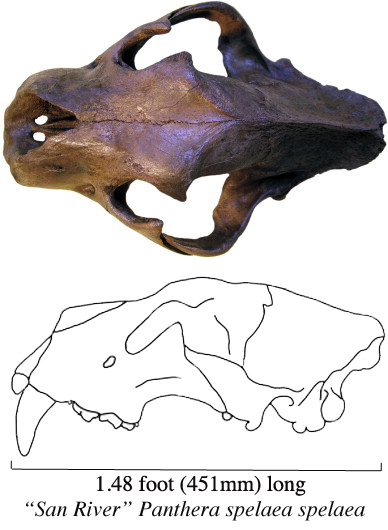
image descriptionAlthough both Radiocarbon and Uranium-Thorium dating methods failed on the San River specimen, the advanced cranial and dental morphology of the specimen is consistent with a male Late Pleistocene Panthera spelaea spelaea, most probably from the first half of the last glacial. Nonetheless, no intact male spelaea skull from the last glacial has exceeded 400mm (1.31 foot) in length, while the San River specimen was 451mm (1.48 foot) in length (see the image adapted from Marciszak et al., 2014, to the left), suggesting a body size in line with earlier fossilis forms. Consequently, the authors suggest that either the San River specimen is from an earlier period than the cranial and dental morphology indicate, which they consider to be unlikely, or it may simply be evidence that cave lions with impressive dimensions did continue to survive into the Late Pleistocene, even if such specimens were rare. Taken in combination with the fact that the number of fossilis and spelaea specimens is currently so limited that it is not possible to perform a statistically reliable analysis of European cave lion size at the present time (Marciszak et al., 2014), this is a particularly important finding to take into consideration when assessing candidate species for Davon panthers as the decreasing size for the European cave lion might otherwise be considered problematic for the hypothesis that the panthers were living descendants of Panthera spelaea spelaea.

First, one would presume that over the several thousand years between the Late Pleistocene when Panthera spelaea spelaea appears to have died out and the time period in which The Legend of Broken is set, the size of any remaining cave lions (assuming it was possible for any to have survived) would have continued to decrease, not maintain their former megafauna proportions. Indeed, by the end of the cave lion reign in Europe in the first part of the last glacial, “dwarf” cave lions with dimensions similar to medium-sized modern African lions were appearing among the European cave lion population. The finding of a fossilis-sized cave lion from a much later time period than had previously been thought possible for the Late Pleistocene Panthera spelaea spelaea therefore helps the argument that separate lineages of cave lions may have continued to exist in Europe (see also Guzvica, 1998, for further evidence of separated lineages in European cave lion populations), which further helps the case that Davon panthers may have retained their impressive megafauna dimensions over several thousand years.

Second, it is also important to note that, like the European jaguar, the European cave lion was strongly sexually dimorphic with male skulls typically exceeding female skulls by an average of 3.93 inches (10cm) in length. Given the fact that it was a female Davon panther that was said to exceed 500lbs (226kg) in The Legend of Broken, in order for the immature male panther we meet early in the novel to grow to the correspondingly large size the female’s weight would indicate, the only possible way this could have happened is if the original megafauna proportions had been retained. Incidentally, this point also rules out the possibility that Davon panthers were relatives of the ancestors of modern African lions. Although isolated finds indicate that modern lions colonised areas of South-Western Europe as late as the Iron Age (Stuart & Lister, 2011), there is no evidence that they would have reached the proportions required for a Davon panther, nor that any separate line of modern lion would have evolved to increase in size rather than decrease in size.

To Be Continued

Although the size requirements for Davon panthers have now ruled out the possibility of the great cats having evolved from European jaguars or the ancestors of modern African lions, we are faced with the question of the panthers’ hunting and living habits. Within The Legend of Broken we are told that Davon panthers were solitary hunters rather than hunting collaboratively in prides. Does this correspond to the hypothesised hunting pattern of European cave lions? Perhaps surprisingly, recent mitochondrial DNA and bone collagen isotopic signature findings suggest that it does! We will overview this fascinating research, as well as investigating possible extinction hypotheses and the implications these have for the likelihood of Davon panther existence, in Part Two of The Legendary Panthers of Davon Wood series over the coming weeks. | Continue reading →

New Alienist TV Series Page

Although no new information has been released regarding the television adaptation of The Alienist that was first announced in April and May of this year, I have decided to add a new page to The Alienist Books section of 17th Street containing the information that has been released thus far about the adaptation. In addition, The Alienist movie page has been updated to reflect the news about the new television drama series, and The Alienist TV Series blog tag has been added to the side menu. When any new information about the series does come to light, it will be reported here on the main blog as well as on The Alienist TV Series page.

Washington Square by Henry James

We take a break from non-fiction, tenements, and vice this month to venture out of the slums and into the world of old New York gentility. When Caleb Carr was asked during last year’s New York Times web chat to name the key pieces of New York literature he has most admired, he included Henry James’ New York stories on his list, making particular mention of Washington Square which he described as, “one of the most punch-in-the-face stories about polite society ever written”. In consequence of this, we will be visiting the “decorous neighbourhood” of Washington Square—to borrow John Moore’s description of nearby Gramercy Park in The Alienist—this month in order to take a peek behind the respectable facade of Dr. Austin Sloper’s stately early nineteenth century home to examine the sometimes sad, sometimes cruel melodrama that took place within.

What’s it about?

Dr. Austin Sloper, a prominent New York physician, was fortunate to hold among his patients the cream of old New York society. At the age of twenty-seven, he added to his fortunes by marrying the love of his life: a “graceful”, “accomplished”, and “elegant” woman whom he saw as the “bright exception” to the other women of his acquaintance, and who brought to his household the added blessing of ten thousand dollars income. Tragically, misfortune struck only a few years into their happy union. First, Dr. Sloper lost his pride and joy, a three year old son, before he was forced to endure the greater loss of his wife as a result of childbirth two years later. The product of this tragic series of events was Dr. Sloper’s sole surviving heir, a daughter named Catherine, who would go on to become the unexpected heroine in this novel of manners and society.

Washington Square follows the story of the plain-faced, kindhearted, and dutiful Catherine as she traverses her perilous journey to independence. Faced with a charming, handsome suitor whose mercenary motives masquerade behind the facade of a devoted lover; a meddlesome aunt who masquerades as a reliable confidant; and a sharp, detached father who masquerades as a loving, devoted parent, Catherine must learn to see the key players in her life for who they really are if she is to make the right choice between her inheritance and her fiancé.

My thoughts

Even though Henry James would dismiss Washington Square as an “unhappy accident” later in his life, the novel is generally considered by modern audiences to be James’ most accessible work. However, within Washington Square’s simple form—we only follow one main plot within its approximately 250 pages—a social commentary is concealed that is far more complex than it first appears. Novelist Cynthia Ozick summarised the main themes of the novel succinctly in her Introduction to the 2002 Modern Library Classics edition:

Washington Square is a novel about the abuse of imagination, the abuse of trust, the abuse of propriety and form; about, above all, the absence of pity … Though it may be a bad thing to break the rules of a fixed society (disinheritance of a child is such a breach, jilting is such a breach), it is a worse thing to break a heart.

After my recent re-read of the novel for 17th Street, I found myself agreeing with Ms. Ozick; however, I am prepared to go further than Ms. Ozick to suggest that perhaps the theme that sits at the very heart of Washington Square is, in actual fact, that of betrayal. Not necessarily the betrayal that results from a meddlesome aunt manipulating her niece for her own interests, or even the betrayal produced by an opportunistic suitor (although neither of these parties is, in any way, innocent), but the ultimate betrayal—and consequent damage—produced by a father who was not only unable to love his daughter, but actively resented her, going so far as to claim that his only comfort in the loss of his wife was his “satisfaction in the thought that [she] had not lived to find [their daughter] out”. And what was Catherine’s crime? The brilliant doctor was disappointed that he had fathered a “commonplace” daughter. Within the first fifteen pages of the novel, Dr. Sloper’s feelings about his daughter, with her “plain, dull, gentle countenance”, are made brutally clear:

“When Catherine is about seventeen,” he said to himself, “Lavinia [Catherine’s aunt] will try and persuade her that some young man with a moustache is in love with her. It will be quite untrue; no young man, with a moustache or without, will ever be in love with Catherine.”

Although never outwardly cruel toward his daughter, it was Dr. Sloper’s fundamental inability to feel any genuine love or affection toward Catherine that ultimately resulted in his daughter falling victim to the opportunistic overtures of the mercenary suitor Morris Townsend, much to the doctor’s vexation. It was the illusion of love, after all, that comprised the entire attraction Morris held for Catherine, as Ms. Ozick explains in her Introduction to the novel:

Morris is a work of art; he is also an artist. Like a painter or a novelist, he can create a young woman who never before existed. He can transform Catherine, to whom no one has ever shown honest affection, into a woman who for the first time feels herself to be worthy of love.

Of course, the real tragedy of Washington Square is that Catherine is not unlovable. We learn of others in the story who can see Catherine’s virtues for what they really are; but Catherine, having been betrayed by the person she has always held most dear, is unable to see what fairer and unbiased members of society do plainly see.

So, what was it about Washington Square that might have prompted Caleb Carr to describe the novel as “one of the most punch-in-the-face stories about polite society ever written”? After all, the novel is mostly a family drama, and when it comes to “punch-in-the-face stories” about old New York society, one’s mind might first turn to an author like Edith Wharton instead.

Well, aside from the novel bringing the rules of the fixed society in which it was set sharply into focus, perhaps it might also relate to the aforementioned theme, at least in part. Nothing is quite so damaging, so heartbreaking, or so cruel as a parent’s betrayal of their child; a theme that is also at the very heart of the Alienist books. As Washington Square amply demonstrates, betrayal is not a cruelty reserved for the poor, the slums, or even the middle class. It hides behind the stately, respectable facades of neighbourhoods like Washington Square just as readily as it does the tenements of the Lower East Side, and its damage is just as great.

A “punch-in-the-face” story about polite society, indeed.

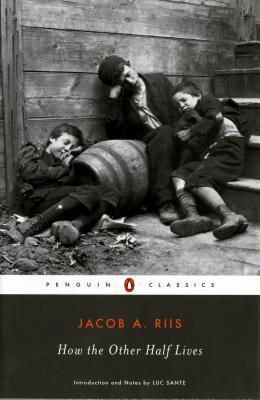
How the Other Half Lives by Jacob Riis

With May 26th having marked the 100th anniversary of the death of Jacob Riis, the Danish social reformer and journalist of the late nineteenth century, it seemed appropriate to feature Riis’ most prominent work, How the Other Half Lives, as 17th Street’s first “book blog” for June. In the New York Times web chat Caleb Carr gave early last year, he cited How the Other Half Lives as one of his most important influences for The Alienist, stating that “very little can beat” it as a contemporary source of information about life in nineteenth century New York. Indeed, readers of The Alienist should already be at least vaguely familiar with Riis thanks to the cameo he received in the novel itself–even if our protagonist, Dr. Laszlo Kreizler, wasn’t terribly fond the crusading Dane.

The Alienist, Chapter 5:

Riis came huffing up behind Steffens, his hulking Danish frame not so lithe as that of the much younger Steffens. “Doctor,” he said, to which Kreizler only nodded. He had a positive dislike for Riis; the Dane’s pioneering work in revealing the evils of tenement life–most notably through his collection of essays and pictures called How the Other Half Lives–did not change the fact that he was a strident moralist and something of a bigot, so far as Kreizler was concerned. And I have to admit, I often saw Laszlo’s point.

What’s it about?

How the Other Half Lives, “Introduction”:

Long ago it was said that “one half of the world does not know how the other half lives.” That was true then. It did not know because it did not care.

These famous lines, referencing François Rabelais’ Pantagruel, open Jacob Riis’ How the Other Half Lives, a short but powerful piece written as an agent for change. In the Introduction to the 1997 Penguin edition, Luc Sante (the author of Low Life, another of Caleb Carr’s cited inspirations) wrote that, “How the Other Half Lives is one of those unusual books that changed history in a material way, directly affecting the lives of millions of people.” This pioneering work, first published in 1890, combined photography, narrative essays, and hard statistics to take the reader on a journey into the slums of New York City in the late 1880s. Although others had previously shed light on the conditions of the poor in New York City, by focusing on immediate, practical problems, and presenting solutions, Riis was able to make an impact in a way his predecessors had not. Notably, even Theodore Roosevelt would find Riis’ work a source of inspiration, and he went on to count Riis as his “main prop and comfort” during his tenure as Police Commissioner several years later; when TR first read How the Other Half Lives, he left his card for Riis at the latter’s Evening Sun offices with the words, “I have read your book and I have come to help.” written on the back.

How the Other Half Lives opens with a brief history of the tenement, ranging from its earliest days in the first half of the nineteenth century when once fashionable single-family dwellings on the East River front had their rooms partitioned to meet growing demands from the city’s steadily increasing workforce, to the multi-story tenements we associate today with New York City of the late nineteenth century; tenements that were built in such numbers that, according to Riis, “on the East Side, in what is still the most densely populated district in all the world, China not excluded, it was packed at the rate of 290,000 to the square mile, a state of affairs wholly unexampled.” Following this short history lesson, Riis takes his reader on a guided tour through the original downtown back alleys of New York City, focusing much of his attention on the notorious Mulberry Bend, before spending the bulk of his text describing the practices and lifestyles of the major ethnic groups that occupied the tenement districts of the late 1880s: the Irish, the Italians, the blacks, the Chinese, the Polish and Russian Jews, and the “Bohemians” (Czechs and Slovaks).

In the final third of the book, Riis introduces his readers to the children of the street, taking us from their infancy as abandoned or cast out “street waifs”, through their middle years as “street arabs”, before presenting a warning about the adult career they are destined to pursue if they receive no intervention during their youth: becoming the “toughs” of New York’s street gangs. Riis then devotes a chapter to the evils of the saloon, another to the dreadful working conditions of females that would make “almost any door … seem to offer welcome escape from such slavery as this” (a subtle insinuation regarding the “opportunity and danger that prostitution presents to poor girls”, as Luc Sante more bluntly put it in his Introduction), the relative merits and problems charitable solutions pose to the problem of poverty, and finally to the possibilities presented by both simple solutions to the problems of the tenements (e.g., having landlords or competent janitors living in the properties at all times to enforce rules of conduct) and more complex solutions (e.g., the construction of “model” tenements that have proper light and ventilation in place of razed tenements).

My thoughts

Throughout my reading, I didn’t find it difficult to understand why How the Other Half Lives became such a powerful impetus for change in the 1890s, nor did I find it difficult to see why Caleb Carr considered it a valuable reference work while writing the Alienist books. Nevertheless, on more than one occasion I found myself agreeing with Dr. Kreizler about Riis during my reading. As easy as much of the book is to read, I found chapters like “Chinatown”, where Riis’ pious missionary zeal and condescending racial prejudices were apparent on almost every page, particularly hard-going, and I needed to give myself frequent breaks. Take the following excerpt as an example.

How the Other Half Lives, “Chinatown”:

At the risk of distressing some well-meaning, but, I fear, too trustful people, I state it in advance as my opinion, based on the steady observation of years, that all attempts to make an effective Christian of John Chinaman will remain abortive in this generation; of the next I have, if anything, less hope. Ages of senseless idolatry, a mere grub-worship, have left him without the essential qualities for appreciating the gentle teachings of a faith whose motive and unselfish spirit are alike beyond his grasp.

Although one might argue that in holding such opinions Riis was simply a man of his time, as Luc Sante pointed out in his Introduction to the text, “it is noteworthy that one anonymous reviewer, writing in The Critic of December 27, 1890, judiciously expressed the book’s shortcomings:”

His book is literally a photograph and as such has its value and lesson, but also its serious limitations. There is a lack of broad and penetrative vision, a singularly warped sense of justice at times, and a roughness amounting almost to brutality. The “Heathen Chinese” and the Russian Jew fleeing from persecution in his own land, find no mercy in Mr. Riis’ creed.

“This blunt summary shows that Riis’ myopia in regard to cultures more foreign than his own origins was not strictly a function of the times in which he lived.” Moreover, as John explains a little further on in The Alienist, there were noteworthy aspects of slum life, such as homosexual and child prostitution, that were completely missing from Riis’ text; aspects John claims Riis “could not accept” despite “all the horrors he had witnessed”. However, do not suppose by these criticisms that I didn’t find the book an interesting or worthwhile read. I found the sections of the text in which Riis takes his reader on guided tours of the slums, employing a conversational tone that relays sights, smells, and sounds in such a way that the reader is almost there beside him, invaluable; Riis’ prose is not florid or sensationalist in nature, and as such he provides a vivid and realistic snapshot of life in the tenements that is fascinating to read, as the following excerpt from a chapter about life in the Jewtown sweater district demonstrates.

How the Other Half Lives, “The Sweaters of Jewtown”:

It is Sunday evening west of the Bowery … Men stagger along the sidewalk groaning under heavy burdens of unsewn garments, or enormous black bags stuffed full of finished coats and trousers. Let us follow one to his home and see how Sunday passes in a Ludlow Street tenement.

Up two flights of dark stairs, three, four, with new smells of cabbage, of onions, of frying fish, on every landing, whirring sewing machines behind closed doors betraying what goes on within, to the door that opens to admit the bundle and the man. A sweater, this, in a small way. Five men and a woman, two young girls, not fifteen, and a boy who says unasked that he is fifteen, and lies in saying it, are at the machines sewing knickerbockers, “knee-pants” in the Ludlow Street dialect. The floor is littered ankle-deep with half-sewn garments. In the alcove, on a couch of many dozens of “pants” ready for the finisher, a bare-legged baby with pinched face is asleep. A fence of piled-up clothing keeps him from rolling off on the floor. The faces, hands, and arms to the elbows of everyone in the room are black with the colour of the cloth on which they are working. The boy and the woman alone look up at our entrance. The girls shoot sidelong glances, but at a warning look from the man with the bundle they treat their machines more energetically than ever. The men do not appear to be aware even of the presence of a stranger.

Other sections relay distressing accounts of children Riis witnessed dying of starvation, babies abandoned on fire-escapes (reminiscent of the scene in The Alienist where John and Sara nearly step on a baby in a dark tenement hallway), and tales of suicides from immigrants too “tired” to go on. Riis introduces us to workers who developed diseases such as lead poisoning that prevented them from providing for their families, and told bittersweet stories such as that of a young boy who was excited to spend a night in Police Headquarters because he was given a bed to sleep in (he was used to sleeping on “a heap of dirty straw on the floor”) and one egg and three slices of bread for breakfast (“his daily diet [consisted of] a crust in the morning, nothing else”). On top of these snapshots of human life, the overcrowding, pay rate, and death rate statistics Riis provided throughout the text were nothing short of staggering.

Considering the racial prejudices that pervade How the Other Half Lives, it is somewhat ironic that perhaps the most important aspect of Riis’ work was his willingness to tackle another common nineteenth century prejudice held by many in the middle and upper classes; that those who lived in the shocking conditions of the tenements deserved or, worse still, chose their fate. Instead, Riis made it clear how, through no fault of their own, many hard-working immigrants found their way into the tenements and lacked means of escape, as well as stressing the importance of the role of the environment in the creation and perpetuation of problems (e.g., crime) that arose out of the tenements. Granted, as a result of Riis’ unwillingness to enquire with any depth into the origins of the social conditions in the tenements, some of his pronouncements were over-simplistic and lack insight (e.g., he occasionally makes unfounded sweeping statements such as “only the poor abandon their children”). However, it was through his willingness to at least accept a role for the environment that How the Other Half Lives proved to be an effective impetus for change in the years following its publication.

Ultimately, How the Other Half Lives is an essential read for anyone interested in learning more about the “other half” (actually closer to three-quarters) of New York’s population at the turn of the century. The limitations of the work notwithstanding, this is an enlightening, if saddening, piece of nonfiction that deserves a place on any Alienist reader’s bookshelf.