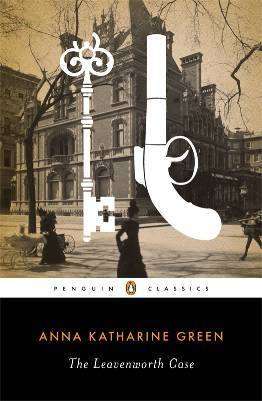
The Leavenworth Case by Anna Katharine Green

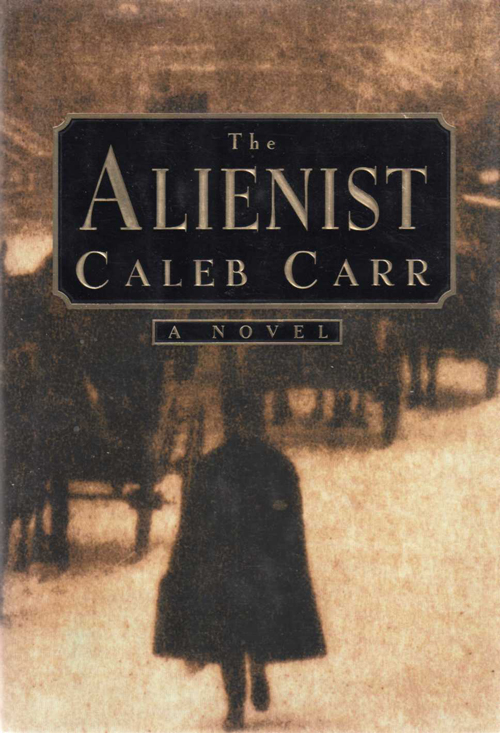
Changing pace from the last few 17th Street book blogs, I have decided to revisit The Alienist’s roots in nineteenth century sensation and detective fiction for February’s book blog. As we discovered in last year’s special three-part series overviewing The Alienist’s themes, one of Caleb Carr’s inspirations while writing the novel was the work of sensation novelist Wilkie Collins, with the Detective Sergeants Marcus and Lucius Isaacson even being described as having been inspired to become detectives after reading Collins’ work as boys. Although not mentioned in the Alienist novels, another author the Isaacson brothers might have enjoyed reading alongside Wilkie Collins was a New York local, Anna Katharine Green, whose first full length detective novel, The Leavenworth Case, quickly became a best-seller when it was published in 1878.

What’s it about?

Set in 1876, The Leavenworth Case opens with narrator, Mr. Everett Raymond of Veeley, Carr & Raymond, attorneys and counsellors at law, being the only partner present in his firm’s office on the morning that one of their most notable clients, Mr. Horatio Leavenworth, was found murdered in his Fifth Avenue mansion. Upon being summoned to the Leavenworth residence to provide legal assistance to the deceased’s nieces during the coroner’s inquest, Mr. Raymond finds himself embroiled in an atmospheric “locked room mystery,” with a house full of suspects, the key to the crime scene missing, stolen papers, a missing lady’s maid, unreliable witnesses, and a beautiful heiress with a mysterious secret. Add the “tireless, rheumatic, and sardonic” Mr. Ebenezer Gryce, the brilliant yet eccentric police detective who plays Sherlock to Mr. Raymond’s Watson, and you have a gripping murder mystery that takes you from streets and mansions of 1870s Manhattan all the way to quiet cottages in the villages of upstate New York.

My thoughts

While reading The Leavenworth Case I found it easy to imagine the Isaacson brothers poring over the novel as boys, bickering about who the most likely suspects might be along with learning as much as possible about the fascinating field of criminal detection and, in Marcus’ case, the law. Indeed, as Michael Sims notes in his excellent Introduction to the novel’s 2010 Penguin edition, The Leavenworth Case was acclaimed by contemporary critics for its accuracy in portraying the legalities surrounding criminal investigation, and was even assigned to law students at Yale shortly after its publication to illustrate the dangers associated with circumstantial evidence. The daughter of a Manhattan attorney, Anna Katharine Green’s careful observations of her father throughout his career clearly influenced her work; Michael Sims goes on to note that even after her father insisted that she show the manuscript to a judge before it went to print, the judge was unable to find fault with the text except for the use of a single word (equity) that she had used in “a colloquial rather than a precise legal sense.”
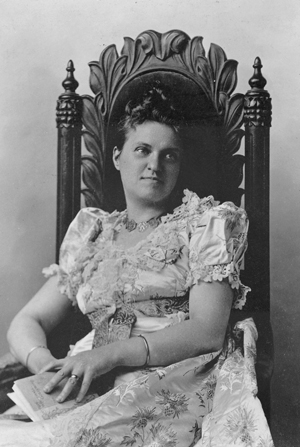
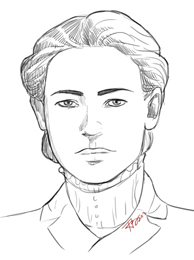
Anna Katharine Green

However, more than just an accurate portrayal of the legalities of criminal investigation in the nineteenth century, Michael Sims notes that The Leavenworth Case is also acclaimed as a genre defining piece of detective fiction. Although the influence of sensation novelists such as Wilkie Collins are readily apparent in the similarities the novel holds to works like The Woman in White (e.g., its inclusion of two young women at the center of the mystery, one of whom the narrator is drawn to for purposes other than the investigation), it is fascinating to see how Anna Katharine Green built upon and established genre conventions that would go on to influence other giants of detective fiction, including such luminaries as Arthur Conan Doyle and Agatha Christie. Beyond elements such as the inclusion of crime scene diagrams and the interaction between the narrator and detective (prototypical of what we have come to associate with Holmes and Watson), Green is also credited as the first major detective novelist who had over three dozen mystery books to her name at the end of her forty-five year career, while her creation Ebenezer Gryce is credited as the first series detective; Sherlock Holmes would not appear in print for another nine years.

From my own perspective, the greatest draw of The Leavenworth Case has to be—as in all good detective fiction—the detective himself, Ebenezer Gryce. Although he bears little resemblance to the fictional detectives who came before or after him, he is no less brilliant, eccentric, or amusing, as we discover from the very first scene in which he appears.

The Leavenworth Case, Book 1: Chapter 1

Mr. Gryce, the detective, was not the thin, wiry individual with a shrewd eye that seems to plunge into the core of your being and pounce at once upon its hidden secret that you are doubtless expecting to see. Mr. Gryce was a portly, comfortable personage with an eye that never pounced, that did not even rest—on you. If it rested anywhere, it was always on some insignificant object in your vicinity, some vase, inkstand, book or button. These things he would seem to take into his confidence, make the repositories of his conclusions, but you—you might as well be the steeple on Trinity Church, for all the connection you ever appeared to have with him or his thoughts. At present, then, Mr. Gryce was, as I have already suggested, on intimate terms with the door-knob.

Gryce also has a wry and appealing sense of humour, as we see further in the novel.

The Leavenworth Case, Book 2: Chapter 13

“Hannah found?”

“So we have reason to think.”

“When? Where? By Whom?”

Drawing up a chair in a flurry of hope and fear, I sat down by Mr. Gryce’s side.

“She is not in the cupboard,” that personage exclaimed, observing without doubt how my eyes went traveling about the room in my anxiety and impatience.

However, in the interests of an honest review, the novel is not without its flaws. Despite kicking off at a rollicking pace, I found the introduction of Mr. Leavenworth’s nieces midway through Book 1 (the novel is divided into four “Books”) to be, at first, off-putting; to say that their introduction also initiates a series of melodramatic exclamations, accusations, and weeping would be, well, something of an understatement. Even so, my advice would be to persist, at least until you’re a few chapters into Book 2 when the melodrama diminishes and the Sherlock and Watson interaction between Gryce and Raymond increases. If you do manage to persist, by the time you reach the end of Book 2 and are well into Book 3, you should find yourself thoroughly hooked, and will begin to understand why Arthur Conan Doyle took the trouble to request a meeting with Green when he made his 1890s tour of the United States, and why Wilkie Collins wrote of Green:

Her powers of invention are so remarkable—she has so much imagination and so much belief (a most important qualification for our art) in which she says… Dozens of times reading the story I have stopped to admire the fertility of invention, the delicate treatment of incident—and the fine perception of event on the personages of the story.

So, if you like detective fiction, sensation novels, or just a good mystery set in New York, it is certainly worth giving The Leavenworth Case a go. Perhaps you too will enjoy it as much as I suspect the Isaacson brothers would have.
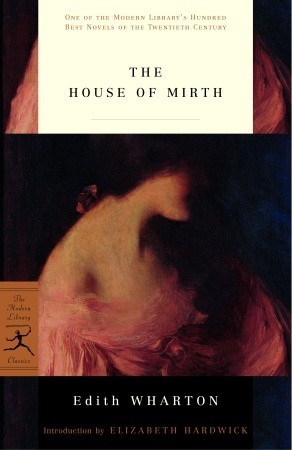
The House of Mirth by Edith Wharton

To follow up 17th Street’s special book blog series on The Alienist, I have decided to present one of my favourite classics by another renowned New York author, Edith Wharton, as the first 17th Street book blog for 2015 given that it also explores several of The Alienist’s central themes. Even though I have never seen any interviews in which Caleb Carr has commented on Edith Wharton’s work, Edith is unquestionably one of the masters of social commentary and psychological insight when it comes to the world of gilded age New York, and The House of Mirth is an excellent starting point for any readers of the Alienist books who might be unfamiliar with her work, with its themes ranging from the role of women in society to psychological determinism.

What’s it about?

It is the turn of the twentieth century, and the beautiful Miss Lily Bart, one of the darlings of New York society, is 29, unmarried, and in need of a husband in order to keep living the luxurious life to which she became accustomed prior to her family’s financial ruin several years earlier. Through Lily’s story, as well as those of the characters who surround her, we witness first-hand the moral, social, fiscal, and psychological implications of one woman’s desire for personal freedom and independence in a cut-throat world where debts—both financial and societal—must be paid, or the consequences suffered.

My thoughts

In his Introduction to Edith Wharton’s autobiography, A Backward Glance, Louis Achincloss wrote:

It was said of Edith Wharton that she and Theodore Roosevelt were self-made men, and the saying pleased her. She and the president, contemporaries and good friends, had grown up together and escaped from the kind of society that was the hardest of all to escape from: the secure, complacent haute bourgeoisie of the late nineteenth century that found politics too dirty for gentlemen and letters too inky for ladies.

Not surprisingly, the concept of personal freedom and what it meant for women and men in the late nineteenth century runs deep in Edith’s 1905 novel, and is evident as early as The House of Mirth’s opening scene. In this scene, Lily Bart is passing time in her friend Lawrence Selden’s bachelor flat while she awaits a train to take her upstate for the summer. While the pair take tea together in Selden’s flat, we are presented with the contrast of an intelligent young woman who feels that she must marry in order maintain her position in society with that of a similarly aged young man who is more than capable of maintaining his position whilst also retaining his independence.

Book 1, Chapter 1:

“But do you mind [having to work] enough—to marry to get out of it?”

Selden broke into a laugh. “God forbid!” he declared.

She rose with a sigh, tossing her cigarette into the grate.

“Ah, there’s the difference—a girl must [marry], a man may if he chooses.” She surveyed him critically. “Your coat’s a little shabby—but who cares? It doesn’t keep people from asking you to dine. If I were shabby no one would have me: a woman is asked out as much for her clothes as for herself. The clothes are the background, the frame, if you like: they don’t make success, but they are a part of it. Who wants a dingy woman? We are expected to be pretty and well-dressed till we drop—and if we can’t keep it up alone; we have to go into partnership.”

Of course, as we have recently seen in The Alienist book blog series, as well as in the Education of Sara Howard history blog series, there was also a growing movement among middle and upper class women in the late nineteenth and early twentieth centuries to push back against the prevailing view that the only respectable occupation for women in society was as a doting wife and mother in the home. We see such women represented in the Alienist books by Sara Howard, and Edith Wharton did not fail to represent these women in The House of Mirth either given her inclusion in the novel of Selden’s cousin, Gertrude Farish. However, in typical Wharton style, Edith pulled no punches in describing how independent women like Gerty were viewed in society, even by those women who might have envied their level of personal freedom.

| Continue reading →

The Alienist by Caleb Carr – Part Three

View Part One, Part Two, and Part Three of The Alienist book blog series.
The Alienist

Here we are again at the close of another year. New Year’s Eve in 2014, however, is a particularly noteworthy date for 17th Street. Not only does it mark the conclusion of the 20th anniversary year of The Alienist‘s publication, it also marks the 9th anniversary of the website. In consequence, I’m pleased to be presenting the final part of the special three part blog series overviewing The Alienist‘s central themes in honor of both milestones.

In the preceding two parts of the blog series, we have explored several of the novel’s central themes, ranging from corruption and hypocrisy to domestic violence and childhood trauma. As we conclude the series in Part Three, we will continue the discussion begun in Part Two that the role of the mother was one of the key differences between the early childhoods of Dr. Kreizler and John Beecham, leading us to explore themes in the novel relating to the role of women in society, the role that mothers can play in domestic violence and childhood trauma, trust and betrayal, regaining control, psychological determinism, and changing the way we think about mental health.

N.b. The following post contains major spoilers for The Alienist. To read a spoiler-free synopsis, please refer to the summary page.

The Role of Women in Society

Although it may seem as though The Alienist‘s sequel, The Angel of Darkness, is the stronger of the two novels in terms of themes tied to the feminine—that is, in its examination of what drives women to kill—it would be a mistake not to acknowledge that the role of women in society, and the role that mothers can play in domestic violence and childhood trauma more specifically, are themes that are as prominently placed in the original novel as in its successor. As early as Chapter 5 in The Alienist when we are introduced to Sara Howard, a close childhood friend of John Moore and one of the first female police secretaries, the unique experiences—and frustrations—of women in New York society of 1896 are brought to our attention.

“Sara—with all the professions open to women these days, why do you insist on this one? Smart as you are, you could be a scientist, a doctor, even—”

“So could you, John,” she answered sharply. “Except that you don’t happen to want to. And, by way of coincidence, neither do I.”

The Alienist, Chapter 5
Sara Howard

Sara’s inclusion in the novel as an intelligent, fiery, competent, and determinedly single-minded woman with the goal of becoming New York’s first female police officer is no accident. While her employment in the novel as police secretary is a clear nod to Theodore Roosevelt’s controversial decision to hire a female secretary upon becoming Police Commissioner (his real secretary, Minnie G. Kelly, was “young, small and comely, with raven black hair”; see 17th Street’s Island of Vice book blog for more information), she is also representative on a more general level of those women in the late nineteenth and early twentieth centuries who had begun to push back against the prevailing view that the only proper role for women in society was as a doting wife and mother in the home; an ideology that had dominated American culture from the late eighteenth century onwards (see 17th Street’s Education of Sara Howard history blog series for more information). However, it is important to note that Sara’s purpose in the novel in terms of social commentary is not strictly historical, as Caleb Carr pointed out in an interview with Salon in 1997:

I wanted to write a book with a female character whose reasons for being in the story did not depend on her falling in love with somebody. Women are still being brought up to believe that they have to build their bodies and their minds toward relationships and not toward independent existences of their own choosing. And I wanted to show that women can do that.

I, for one, appreciate Mr. Carr’s stance on this topic. Only last month The New York Times ran a piece pointing out that despite the bleak statistics on marriage, a large number of young women still see the “fairy-tale wedding” as their crowning moment in life, with the wedding gown continuing to be viewed by many as “the most important dress in the life of a woman,” as Oscar de la Renta stated in a recent Vogue magazine spread. As the author of the NYT piece pointed out, “He probably wasn’t considering what a woman would wear, say, as she accepted a Nobel Peace Prize, or was being sworn in as the president of the United States.” Clinical psychologist Sue Johnson went on to explain this mentality in the NYT piece using language strongly reminiscent of the woman’s sphere ideology of the nineteenth century, “Hillary Clinton might be the first female president, but a woman still wants this badge of legitimacy that she is wanted and desired by a man.” Accordingly, the inclusion of an independent female who remains single by choice in a bestseller such as The Alienist is a breath of fresh air, even if, as Dr. Kreizler observes to John:

“Women of such temperament,” he said as we moved to the carriage, “do not seem fated for happiness in our society. But her capabilities are obvious.”

The Alienist, Chapter 9

“There is more than one type of violence, Doctor.”

Taking the role of women in society one step further, one of the less well-recognized themes in The Alienist is the role that women, specifically mothers, are capable of playing in domestic violence and childhood trauma. Although most readers would recognize this theme from The Angel of Darkness where the murderer was a woman who, lacking Sara’s financial freedom and family support, had been expected to fulfill the role of wife and mother—a role to which she was wholly unsuited, and was unable to come to terms with—the theme is, in fact, just as important in The Alienist.

| Continue reading →

The Alienist by Caleb Carr – Part Two

View Part One, Part Two, and Part Three of The Alienist book blog series.
The Alienist 2006 Edition

As we fast approach the conclusion of the 20th anniversary year of The Alienist‘s publication, I am honoring the milestone for the second last time on 17th Street with Part Two of a special three part blog series examining the novel’s central themes. In addition to presenting The Alienist as a superb piece of historical fiction, Part One in the blog series explored two of the novel’s central themes—corruption and hypocrisy—to help to explain why the investigative team attracted so many “powerful enemies” as they pursued their killer. Specifically, it was their enemies’ fear of exposure of “all the hidden crimes that we commit when we close ranks to live among each other,” as Dr. Kreizler put it at the conclusion of The Alienist, that was so very dangerous to the city’s power brokers at the time. As we continue our discussion in Part Two, we will be examining these “hidden crimes” more directly as we explore some of the themes in the novel that relate to the hidden world of the family behind closed doors.

N.b. The following post contains major spoilers for The Alienist. To read a spoiler-free synopsis, please refer to the summary page.

Society’s Secret Sins

One of the more surprising twists in the final chapters of The Alienist was the assistance provided by Paul Kelly’s right-hand man, eat-’em-up Jack McManus, during John Moore and Dr. Kreizler’s final confrontation with the killer. Puzzled about why Kelly, a notorious gangster, might have decided to help the doctor in such an essential way given his efforts to cause mayhem and disruption earlier in the investigation (see Part One), one of the final scenes in the novel involves John visiting Kelly at the latter’s New Brighton Dance Hall. Although Kelly feigns ignorance about the part his henchman played in the crucial battle, he does provide John with one tantalizing hint regarding his motives.

“I’m not saying I know anything about it, of course. But ask yourself this when you get a free minute—of all the people who were up there tonight, who do you think is really the most dangerous to the boys uptown?”

The Alienist, Chapter 46
Anthony Comstock

This view is reflected in the outrage we see the censor of the United States Post Office, Anthony Comstock, express during a meeting he and other prominent New York figures, including the famed financier J. P. Morgan, have with John and Dr. Kreizler early in Part III of the novel. Comstock claims during this meeting that he believes it is Dr. Kreizler’s intent to “spread unrest by discrediting the values of the American family and society” through the pursuit of an investigation that relies heavily on a theory founded in psychological determinism being found to have merit; specifically, Dr. Kreizler’s theory of “context” in which it is proposed that an individual’s personality and behavior in adulthood is determined by his or her experiences during infancy and childhood. Comstock is not alone in his concerns, with J. P. Morgan joining Comstock in expressing his misgivings about the implications of Dr. Kreizler’s theory as well.

“Mr. Comstock has the energy and brusqueness of the righteous, Dr. Kreizler. Yet I fear that your work does unsettle the spiritual repose of many of our city’s citizens, and undermines the strength of our societal fabric. After all, the sanctity and integrity of the family, along with each individual’s responsibility before God and the law for his own behaviour, are twin pillars of our civilization.”

The Alienist, Chapter 30

Although Dr. Kreizler successfully contends during the meeting that he has never “argued against the idea that every man is responsible before the law for his actions, save in cases involving the truly mentally diseased,” this is not the first time Dr. Kreizler has faced open opposition to his work or theories. Indeed, early in the novel we see John express his disbelief that Police Commissioner Theodore Roosevelt would so much as countenance the Doctor taking part in any police investigation given the general public’s opinion of his friend’s work.

| Continue reading →