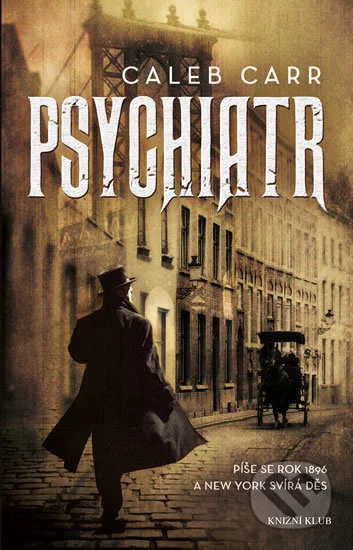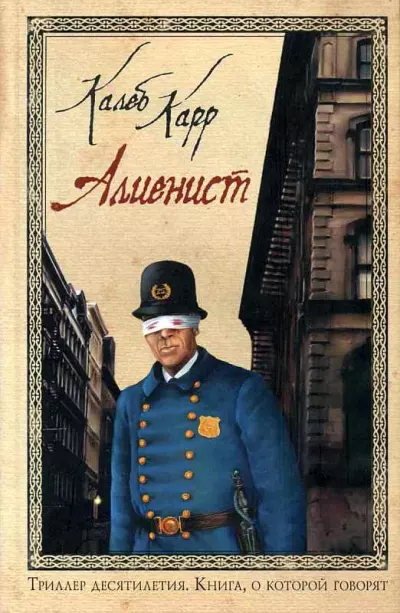
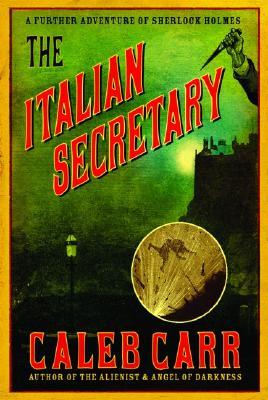
As the year draws to a close, it brings with it two significant milestones: the 20th anniversary of The Italian Secretary, and with it, the 20th anniversary of 17th Street itself. Although I fell in love with Caleb Carr’s work several years before opening 17th Street, it was The Italian Secretary — Caleb’s homage to Sir Arthur Conan Doyle, the author who shaped his literary life — that ultimately inspired me to pay my own tribute to Caleb’s work, a tribute that has continued to grow over the past two decades. To mark this occasion, I have therefore decided to put together a short blog series to honor the book that inadvertently started it all.
In the first two parts of this series, we will explore the various facets of Caleb’s inspiration for the novel, ranging from the supernatural (Part One) to the historical (Part Two). The series will conclude in Part Three with the intriguing hypothetical raised in the novel’s afterword: What might have happened had Caleb decided to take the plunge and blend the world of The Alienist with that of Conan Doyle? The afterword framed the idea as a meeting that would delight and fascinate mystery readers (“Dr. Kreizler, Mr. Sherlock Holmes…”), but is that truly the direction Caleb would have taken?
So, if you haven’t done so already this year, I hope you’ll join me in picking up your copy of The Italian Secretary for its 20th anniversary to explore it in a way you may not have done before. Let us leave 17th Street behind then, to journey back to 221B Baker Street and the Scottish border beyond!
No Ghosts Need Apply
I attempted the most severe tone possible, given the increasingly late hour and our growing need for haste: “You might have shown more respect for her beliefs, Holmes, different though they are from your own.” At that, I hurried off to my bedroom, and began hurriedly packing some few items into a Gladstone.
The Italian Secretary, Chapter 2
Holmes’s distinctly puzzled voice drifted in: “And what makes you think they are so different, Watson?”
“All I mean to say,” I elaborated, going into a closet to fetch my rods and tackle, “is that if Mrs. Hudson entertains notions about hauntings and ghosts, why go out of your way—”
“Oh, but I entertain such notions myself, Watson.”
The notion that Caleb Carr, a lifelong Sherlockian and creator of Dr. Laszlo Kreizler, pioneer in forensic psychology, would write a Holmes tale in which the eminently rational detective entertains the possibility of a supernatural — indeed, ghostly — origin for a series of murders might, at first glance, invite surprise. It was Holmes, after all, who famously stated in The Adventure of the Sussex Vampire: “The world is big enough for us. No ghosts need apply.” The occult does not feature in the Alienist novels either. Readers might recall Dr. Kreizler’s exchange with John on the topic following the secret exhumation of Matthew Hatch in The Angel of Darkness:
“Do you think Matthew Hatch will reach out from the grave, Moore?” the Doctor needled. “To rebuke you for disturbing his eternal rest?”
The Angel of Darkness, Chapter 33
“Maybe,” Mr. Moore answered. “Something like that. You don’t seem too damned troubled along those lines, Kreizler, I must say.”
“Perhaps I have a different understanding of what we’ve just done,” the Doctor answered, his voice growing more serious. “Perhaps I believe that Matthew Hatch’s soul has not yet known peace, eternal or otherwise—and that we represent his only chance of attaining it.”
Why, then, did Caleb decide to write a tale centered on other-worldly subject matter for his contribution to the Holmes legacy? As it turns out, the idea was not his at all. In the afterword of The Italian Secretary, the U.S. representative to the Conan Doyle Estate, Jon Lellenberg, explained that he and co-editors Daniel Stashower and Martin Greenberg had decided to commission a set of short stories for a new collection, Ghosts in Baker Street, in which Holmes would be brought face-to-face with the paranormal. Lellenberg acknowledged feeling some misgiving at the decision. After all, ghosts are “non-canonical,” and he was not at all sure that Conan Doyle would approve. Nevertheless, there is no denying that the detective’s most famous adventure was about a spectral canine; and so, with The Hound of the Baskervilles providing “excuse and inspiration,” he gave permission to proceed. This, however, doesn’t explain why Caleb agreed to contribute.
That Caleb would be willing to accept a commission to write a Holmes tale at all requires no explanation. From his youth, he was an avid reader of Conan Doyle. As he explained in an interview for The Sherlock Holmes Companion in 2009: “I grew up in a very crazy household and the stories’ appeal was that process of using reason to deal with people and the extreme things they do.” His love of Holmes extended to the film adaptations as well. When asked how hard it was to write in Conan Doyle’s voice in an interview with CBS in 2005, he responded that it wasn’t difficult for him: “I could speak like Basil Rathbone being Sherlock Holmes by the time I was ten.” Yet, this still doesn’t answer the beguiling question of why he chose this particular story.
It seems fair to say that Caleb’s love of Holmes, longstanding friendship with Lellenberg, and inspiration he drew from a trip to Edinburgh several years earlier (more on this in Part Two) all played important roles in his willingness to accept the Estate’s commission. Indeed, according to the novel’s afterword, it was Caleb’s fascination with the real historical crime that sits the heart of the story which resulted in it growing to such an unwieldly length that it necessitated separate publication as its own novel, rather than forming part of the original commissioned collection. But even this doesn’t explain why he decided to accept the challenge of a Holmes story with supernatural themes.
The nearest answer one can get can be found in his interview with The Sherlock Holmes Companion. When asked what challenges he faced in writing a new Holmes story, he responded in part:
The big challenge was to make it faithful. When I was asked to do it, they said I should try to be faithful but try to add something of my own. That threw me into a bit of a loop for a while. Because I wanted it to be as faithful as possible, but I knew that they didn’t just want a carbon copy. I wasn’t originally going to do anything connected to the supernatural, even though I’ve always been fascinated by that part of Conan Doyle’s life […] There are a lot of fans who really don’t think Holmes should or would be involved in any supernatural stuff. They quote the line about ‘no ghosts need apply’ but on the other hand there are lots of stories where he concedes the possibility of other dimensions in life. And that conveniently gets forgotten. So that was another reason to bring in the supernatural element. But I knew that would be hard. It had to play a crucial role but not the crucial role. The story would have to work without it. And that was a difficult line to walk.
Thus, to understand how Conan Doyle’s interest in the supernatural may have played a role in Caleb’s decision to agree to include a supernatural element in The Italian Secretary, it is necessary to explore Conan Doyle’s involvement in Spiritualism and how this influenced his own work.
Conan Doyle and the Unseen World
Perhaps the greatest of the Sherlock Holmes mysteries is this: that when we talk of him we invariably fall into the fancy of his existence. Collins, after all, is more real to his readers than Cuff; Poe is more real than Dupin; but Sir A. Conan Doyle, the eminent spiritualist of whom we read in Sunday papers, the author of a number of exciting stories which we read years ago and have forgotten, what has he to do with Holmes?
T.S. Eliot
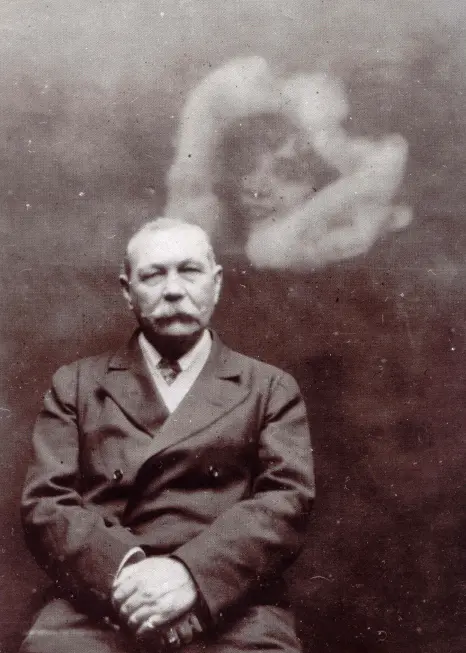
When Sir Arthur Conan Doyle and his family arrived in New York City in 1922, he was at the height of his fame. Now 62 years of age, the creator of Sherlock had published all four Holmes novels, four collections of Holmes short stories, numerous works of historical and science fiction, volumes of military history, and even collections of poetry. Yet, this trip was not a book tour. The eminent British author had made the passage across the Atlantic to embark on a three-month-long speaking tour of the United States and Canada about his new life’s passion: Spiritualism.
Founded in 1848, the Spiritualist movement emerged in upstate New York, when the Fox sisters’ rappings (said to be produced by communication with spirits) were put on display during a series of public demonstrations across the Northeast. From these humble origins, the movement expanded into private homes, churches, and public halls across America and Britain, drawing in those who were skeptical, grieving, or simply eager for the possibility that death did not sever the bonds of affection. Spiritualists believed that human personality survived bodily death, that communication between the living and the departed was not only possible but natural, and that mediums served as intermediaries capable of bridging the two worlds. By late century, séances, trance sittings, table tilting, and automatic writing were no longer fringe spectacles but part of a widespread cultural conversation about consciousness and the limits of the material world.
If it seems strange that Conan Doyle, whose most lauded creation reveled in the rational, had become a passionate defender of this new metaphysical movement, it is worth remembering that the public of the time were no less enthusiastic. On his 1922 tour alone, he filled Carnegie Hall six times with standing-room only crowds. The following year, he filled it three times. Despite its detractors, Spiritualism had moved into the mainstream, with many of the most enlightened minds of the age, including such luminaries as psychologist William James and physicist Sir Oliver Lodge, wishing to investigate the reported phenomena. To facilitate this, the Society for Psychical Research was established in 1882 to bring scientific scrutiny to claims of apparitions, mediumship, telepathy, and other experiences that challenged traditional explanations. It was in this environment, where the scientific and the spiritual met, that Conan Doyle’s own interest deepened and eventually transformed into the lifelong passion he would champion so publicly.
Although modern readers of Sherlock may scoff at Conan Doyle’s involvement with Spiritualism, particularly when it led to him endorsing the ‘coming of fairies’ which was later exposed as a hoax, it is noteworthy for our purposes here that Caleb did not share this cynical attitude. As noted earlier, Caleb explained in his interview for The Sherlock Holmes Companion that he was “always fascinated” by this part of Conan Doyle’s life, going on to say:
I understood why he got involved with Spiritualism and the fairy hoax. There was some kind of pathos in the story that I found very humanizing. At times you could almost lose sight of him as a human because he was so larger than life and he lived by these principles that he exhorted other people to live by. When his son died in the war it was such a crushing thing for him and he got more heavily involved with that stuff, seeing mediums to try and talk to his son.
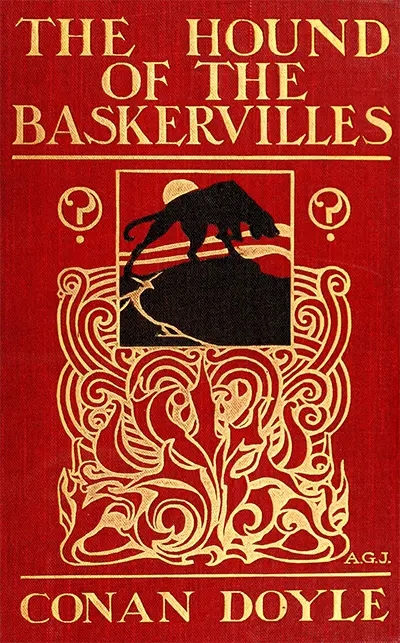
Beyond this general sympathy, Caleb was also of the view that there were Holmes stories in which the detective “concedes the possibility of other dimensions in life”. In addition to The Hound of the Baskervilles, which is the clearest example of Holmes confronting an ostensibly supernatural threat, several other stories demonstrate that Conan Doyle was open to allowing the uncanny to cast its shadow before unveiling the rational explanation behind it. The Adventure of the Sussex Vampire is the most frequently cited case, with its teasing suggestion of vampirism (even if this was the story where Holmes stated ‘no ghosts need apply’). The Adventure of the Devil’s Foot, too, places Holmes and Watson in an atmosphere that borders on the occult. In each instance, Conan Doyle ultimately reasserts reason, yet the stories themselves suggest an author comfortable letting the boundary between the natural and supernatural blur just long enough to unsettle both his characters and readers.
We can therefore see that The Italian Secretary was, in fact, exploring subject matter that was both within Conan Doyle’s own field of interest and wasn’t out of keeping with the canonical Holmes stories. However, to gain insight into why Caleb chose the specific haunting that lies at the heart of the novel, we must turn from Conan Doyle’s worldview to the real historical crime that first captured Caleb’s imagination, a story that takes us to the Royal Palace of Holyroodhouse.
I hope you’ll join me next month for Part Two as we delve into the true crime that inspired the novel, before we conclude our celebration by exploring how the worlds of Holmes and Kreizler might have come together, as suggested in The Italian Secretary’s afterword.